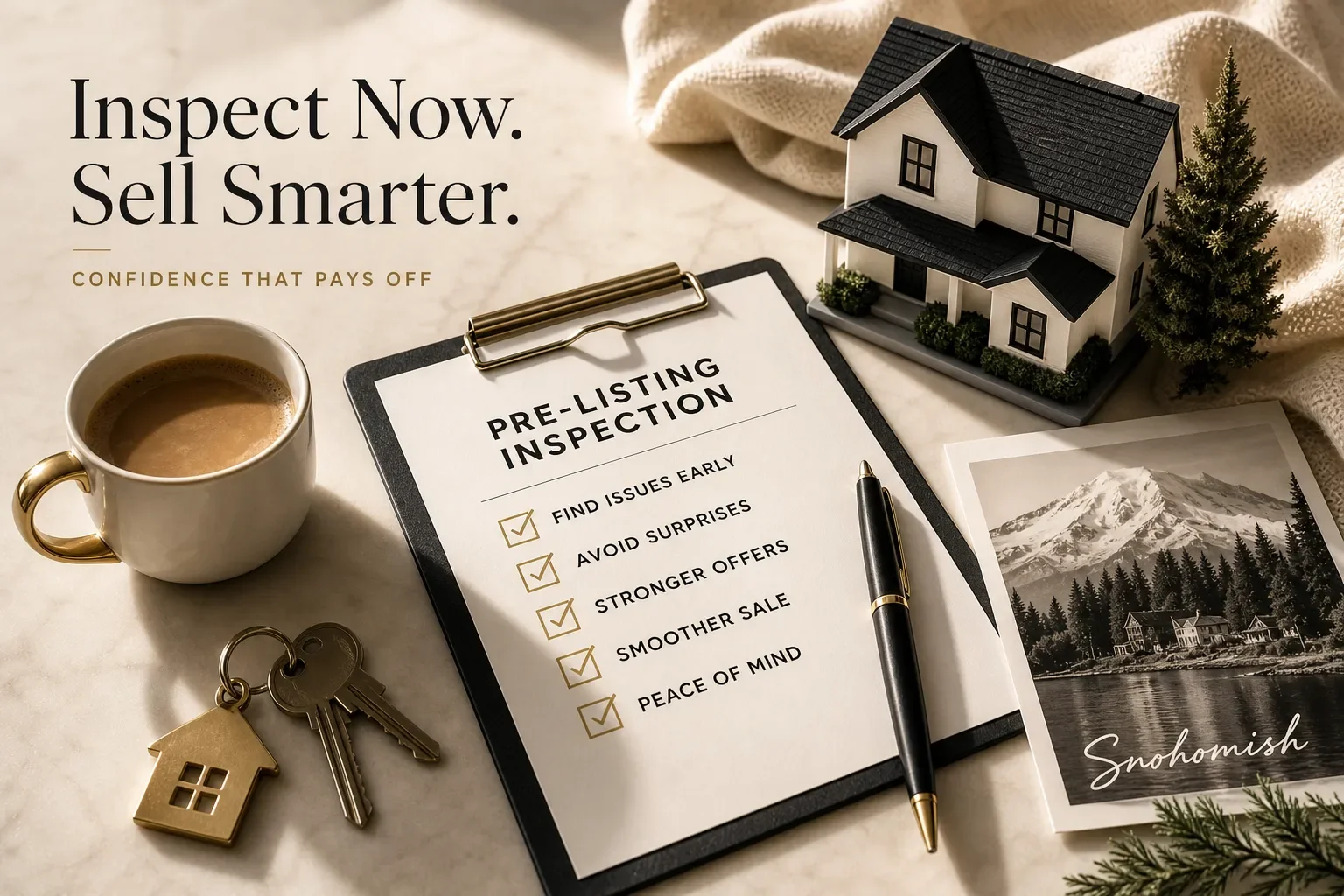
A pre-listing inspection puts you in control: you find the problems before buyers do, which can help reduce their renegotiation leverage and lower the risk of a deal unraveling late in escrow. For sellers in Snohomish County, this is especially valuable right now, with new septic transfer requirements in effect as of November 2026 and a market where buyers are taking longer to decide, Snohomish County residential sales ran a median of 28 days in April 2026, up from 19 days the prior year, according to Northwest MLS data.
The Serviss Group works with sellers across Snohomish, Monroe, Lake Stevens, and surrounding communities. A common question from sellers during listing prep is whether a pre-sale inspection is worth the upfront cost. The honest answer depends on your property and your neighborhood, but for most Snohomish County sellers, the case is strong. Here are the five reasons why.
Key takeaways
Control the narrative: A seller inspection means you discover defects first, giving you time to fix, price, or disclose on your own terms before buyers are involved.
Septic compliance is now mandatory: As of November 1, 2026, Snohomish County requires sellers of septic-served properties to complete a certified inspection before closing.
Not every defect needs a repair: Safety issues and visible deferred maintenance are almost always worth addressing; major systems are more situational.
Disclosure creates trust: Sharing a clean report with repair records can reduce buyer hesitation and second-guessing during escrow.
1. You remove the buyer's biggest negotiating tool before they ever walk through the door
In a standard transaction, the buyer orders their own inspection after going under contract. Anything the inspector flags becomes leverage: price reductions, repair credits, or in some cases a canceled deal. Sellers who haven't done their own inspection go into that moment blind. They find out about the cracked heat exchanger or the failed crawl-space vapor barrier the same day the buyer's agent sends a repair addendum.
A seller inspection flips that dynamic. You already know what's there. You've had time to get contractor bids, decide what to fix, and price the home with accurate information rather than hope. That's not a small advantage, especially in a market where buyers are taking longer to decide. Northwest MLS data shows Snohomish County residential sales taking a median of 28 days in April 2026, up from 19 days the prior year. More time on market means more time for buyers to build a case for renegotiation. Getting ahead of that is simply smart positioning.
Snohomish County inspectors consistently flag a core set of issues tied to the region's climate and housing stock. The most common include moss accumulation and worn flashing on roofs, moisture intrusion and inadequate vapor barriers in crawl spaces, aging furnaces or heat pumps past their service life, and outdated electrical panels with missing GFCI protection. The inspector typically spends two to four hours on site and delivers a detailed digital report with photos within 24 to 48 hours, categorizing findings by severity rather than issuing a pass/fail verdict.
2. Snohomish County's new septic rule changes the timeline: here's what sellers need to know
As of November 1, 2026, the Snohomish County Health Department requires sellers of properties served by on-site septic systems to complete a full septic inspection by a certified contractor before closing. The inspection must be conducted within the preceding 12 months. Sellers must submit a Report of Property Transfer to the Health Department, provide the buyer with the accepted report and maintenance records, and correct deficiencies required under WAC 246-272A-0270 and Snohomish County Board of Health Code chapter 5.55. If the inspection recommends pumping, the tank must be pumped. If the existing as-built on file is inaccurate or missing, the contractor must prepare a qualifying site plan.
For properties in rural areas of Snohomish County, including Three Lakes, Lord Hill, and Fobes Hill, where septic systems are common, this step is now effectively mandatory. The reviewed Report of Property Transfer is valid for 12 months from acceptance, according to the Snohomish County Health Department. Waiting until a buyer is under contract to discover a system issue puts you in a defensive position with a closing deadline approaching. Ordering the septic inspection in Lynnwood or anywhere else in the county yourself, before listing, gives you time to understand what the system needs, obtain repair estimates, and handle any deficiencies without a buyer watching over your shoulder.
3. Which repairs are actually worth making before you go live?
Not every inspection finding justifies a repair before listing. The question is whether fixing something will generate more than it costs in terms of buyer confidence, offer price, or reduced negotiation friction. Safety issues and items buyers will immediately notice are almost always worth addressing. Deferred maintenance that is obvious but inexpensive to fix, like a broken handrail or a caulking gap around a tub, signals neglect to buyers far out of proportion to its actual cost.
Larger-ticket items are more situational. A roof with five years of life left may not need full replacement. An HVAC system that works but is aging may be better handled through a price adjustment or a home warranty disclosure than a full swap. The goal is not to renovate the home, it's to remove the findings that would cause a reasonable buyer to walk away or demand a significant credit. These are planning figures, not quotes. Actual costs depend on access, scope, permits, and contractor availability in your specific area; get at least two bids before committing to any major repair.
High-value repairs to prioritize
Safety deficiencies, failed systems, and anything clearly visible during a showing typically offer the strongest return on pre-listing investment. Address these first.
Lower-value fixes to evaluate carefully
Cosmetic updates and partial system replacements on functioning equipment often return less than their cost. Discuss the trade-offs with your agent before spending.
4. How should you use the inspection report once you have it?
There are two main ways to handle a pre-listing inspection report. You can share it openly with buyers and their agents as part of your listing disclosure package, or you can use it internally to inform pricing and repairs without distributing the full report. Each approach has real trade-offs, and the right choice depends on your property and what the report says.
Sharing the report signals transparency and can reduce the likelihood that buyers order a redundant inspection, which shortens the timeline and reduces opportunities for second-guessing. It also demonstrates that you know the property well, which builds trust. The downside is that sharing a report creates disclosure obligations under Washington State law: once you are aware of a material defect, you generally cannot omit it from your seller disclosure statement. The Washington Department of Licensing is clear on this, once you know about a material defect, it goes on your seller disclosure form. You can't substitute a report for a proper disclosure.
Sellers who disclose known issues proactively, backed by an inspection report and contractor bids, can put buyers in a stronger position to write confident offers rather than padding in a risk discount for the unknown. Buyers in Snohomish County are accustomed to older homes, varied lot conditions, and septic systems. What they want to avoid is uncertainty. A clean, well-documented presale inspection with repair records attached removes that uncertainty and gives buyers a foundation to write an offer without second-guessing what might be lurking. Before distributing any report or revising your disclosure form, review the findings with your agent and, for material or ambiguous issues, a real estate attorney.
5. What does a pre-listing inspection cost in Snohomish County, and does the math work?
The return on a pre-listing inspection isn't the same in every Snohomish neighborhood. A 1960s ranch in Dutch Hill has different inspection realities than an acreage property in Three Lakes or a Craftsman in the Historic District. That's where working with someone who knows these micro-markets makes a practical difference. At The Serviss Group, we help sellers in each of these areas map out which pre-listing steps carry the highest return and which ones can be skipped without leaving money on the table.
The bottom line for Snohomish sellers
A pre-listing inspection is not about achieving a perfect home. It's about replacing uncertainty with information and giving yourself the time to act on it before buyers are involved. The cost of the inspection is modest relative to the renegotiation risk it can help reduce, particularly for older homes, rural properties, or any home with a septic system now subject to the county's new transfer requirements.
The sequence is straightforward: order the inspection early, review the findings with your agent, and decide what gets fixed and what gets disclosed. That approach puts you in control from the first showing to the final signature, rather than scrambling to respond to a buyer's repair addendum at the worst possible moment.
If you're preparing to sell in Snohomish, Monroe, Lake Stevens, or the surrounding area and want a clear-eyed look at which pre-listing steps make sense for your specific property, reach out to The Serviss Group.
Frequently asked questions about pre-listing inspections in Snohomish County
How long is a pre-listing inspection report valid?
There is no universal expiration date for a standard home inspection report, but most buyers and agents treat reports older than six months with added skepticism because conditions can change. For septic-specific inspections under Snohomish County's transfer requirements, the reviewed Report of Property Transfer is valid for 12 months from acceptance by the Health Department.
Who pays for septic repairs discovered during a pre-listing inspection?
If you order the inspection before listing, you are responsible for addressing any deficiencies required under county code, including those under WAC 246-272A-0270 and Snohomish County Board of Health Code chapter 5.55, before closing. Ordering the inspection early gives you time to get competitive bids and decide how to handle larger repairs rather than negotiating under a contract deadline.
Does a pre-listing inspection replace the buyer's inspection?
No. Most buyers will still order their own inspection. What the seller inspection does is reduce surprises: you know the property's condition before offers come in, and buyers reviewing your inspection report and repair records have less to discover on their own. That can shorten the inspection contingency period and reduce late-stage renegotiation.
Are there Snohomish County home sale requirements beyond the standard inspection?
For properties on septic systems, yes, the county's property transfer inspection requirement, effective November 1, 2026, is mandatory before closing. Standard home inspections are not required by county code but are expected by virtually every buyer. Some transactions also involve sewer scope inspections, pest inspections, or well water testing depending on the property type and location.