Where to Find Rural Homes in Snohomish County in 2026
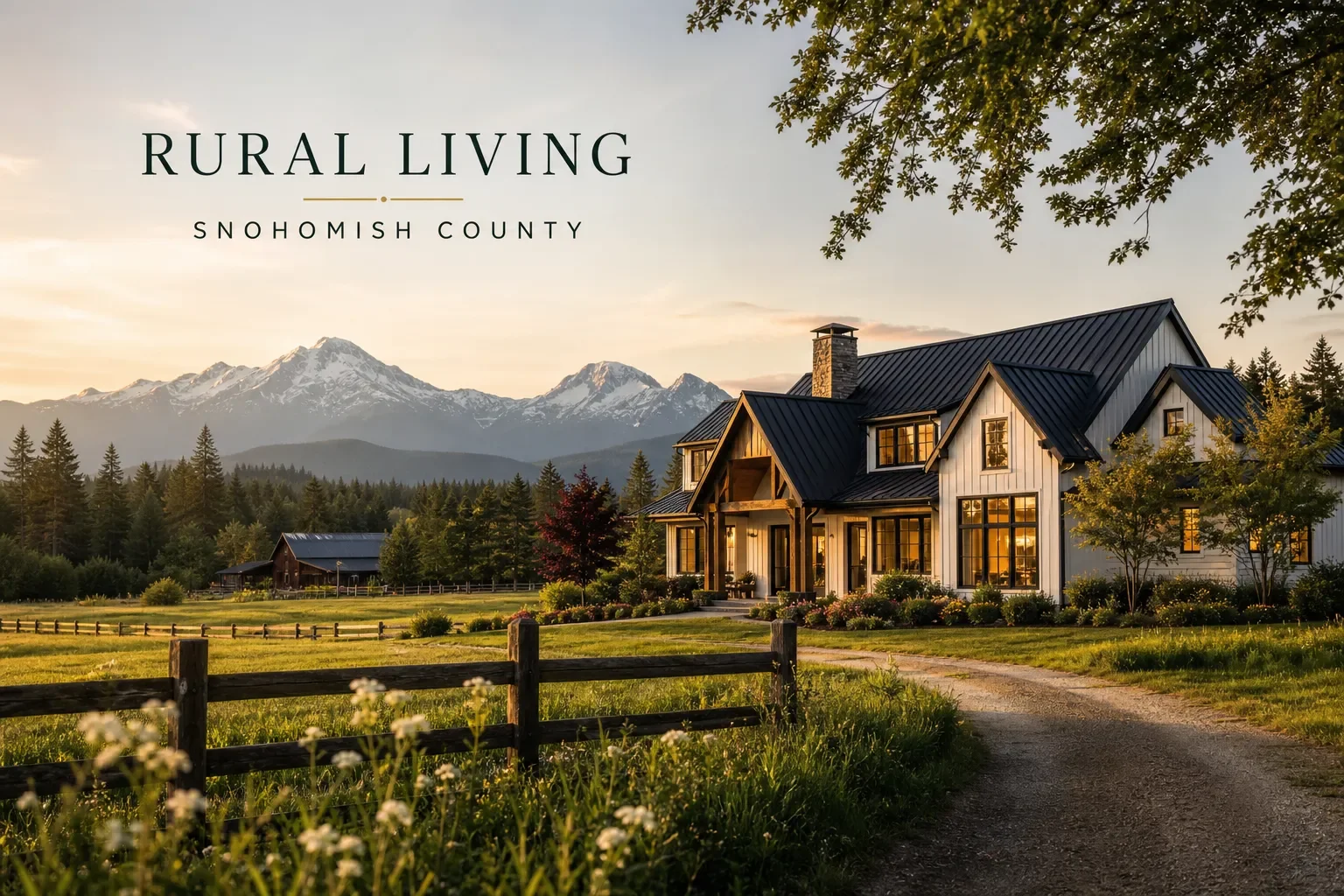
Rural acreage within reasonable commuting distance of Seattle has grown genuinely hard to find. Much of the available land has been absorbed by subdivisions over the past decade, and buyers who search too broadly end up disappointed by what's actually on the market. The good news: there are still Snohomish County communities where buyers can find rural properties with real land under them, whether that's a hobby farm, a forested parcel, or a house on five acres with room for a shop. The trick is knowing exactly where to look and what each community actually delivers.
This guide breaks down the specific communities across Snohomish County where acreage and rural properties are actively listed in 2026, what you can expect to pay, what lot sizes look like, and the non-negotiable due diligence items that separate a smooth rural purchase from an expensive lesson. What you'll find below is ground-level and community-specific rather than generic county-wide advice.
Rural Communities Right Outside Snohomish City
The highest-demand rural communities in the county cluster close to the Snohomish city core. That proximity gives buyers the privacy of acreage living without sacrificing access to schools, grocery stores, and the Highway 2 corridor. Three Lakes, Lord Hill, Dutch Hill, and Fobes Hill consistently show the tightest inventory and the strongest resale history in this cluster, which matters when buyers are comparing long-term land value.
Three Lakes: A Rural Pocket With Genuine Community Character
Three Lakes remains one of the few areas in the county where you can still find horse-friendly lots, small hobby farms, and two-to-ten-acre parcels within an established residential setting. Median home prices in the area run between $1.05 million and $1.22 million based on recent sales data, with typical homes around 2,600 square feet on larger lots. The lifestyle draw is real: quiet roads, meaningful setbacks from neighbors, room for outbuildings, and a community of people who specifically chose land over density.
Lord Hill: Forested Privacy Adjacent to a Regional Wilderness Park
Lord Hill sits next to Lord Hill Regional Wilderness Park, and that permanent green buffer is something buyers genuinely value. Parcels here tend toward larger footprints and heavier tree coverage, appealing to buyers who want more separation from neighbors rather than simply more square footage. That same isolation deserves the most careful evaluation: road access quality, well condition, and proximity to emergency services all require extra scrutiny here. Buyers who do that homework upfront tend to love what they end up with.
Fobes Hill: Mixed Residential-Rural With a Quiet Reputation
Fobes Hill functions as a transitional community where rural lot sizes and more conventional neighborhood layouts exist side by side. It attracts buyers who want some land without the full management commitment of a larger farm parcel, and its proximity to solid school corridors comes up frequently as a deciding factor for families. Pricing here tends to sit in a more accessible range than Three Lakes, making it a practical entry point for buyers who want to be close to Snohomish city without stretching into the upper end of the market.
Outer Snohomish County Communities Where Buyers Can Still Find Rural Properties
Once you expand your search beyond the Snohomish city cluster, the county opens up considerably. These communities offer more active inventory, larger lot sizes for less money, and different tradeoffs around commute time and infrastructure access. Active MLS data in 2026 shows listings in Monroe, Arlington, Granite Falls, Sultan, and Maltby, each with a distinct appeal and buyer profile.
Maltby and the Snohomish-Woodinville Corridor
Maltby sits near the King County line and draws buyers who want rural character while staying within reach of the Eastside job market. Lot sizes here tend to run smaller than Lord Hill but larger than standard suburban lots, and pricing reflects that in-between positioning. Because this corridor competes with parts of King County for buyer attention, values here have shown relative resilience in some market windows even when broader conditions soften.
Monroe, Arlington, and the Highway 2 Corridor
Monroe offers active acreage listings in the $750,000 to $1.75 million range for homes on land, illustrative examples from current MLS activity, making it a practical alternative with real inventory for buyers who can't find what they need closer to Snohomish. Arlington, further north, shows active listings at smaller price points for four-to-five-acre parcels, which makes it a realistic starting point for buyers working with tighter budgets. The honest tradeoff is a longer commute and fewer walkable amenities, so this corridor tends to suit buyers who have already made peace with a rural lifestyle rather than buyers still testing the idea.
Granite Falls and Sultan: The Best Land-Per-Dollar Ratio in the County
These two communities are the county's most affordable rural entry points, with active land listings in the $289,000 to $349,950 range based on current MLS activity. Commute times are longer and services are thinner, but for buyers whose priority is land size or a future build, Granite Falls and Sultan offer the most acreage for the dollar anywhere in Snohomish County. Buyers who go in with clear-eyed expectations tend to find them extremely satisfying; those who underestimate the lifestyle adjustment often struggle with the transition.
What to Evaluate Before Buying Rural Property
Rural purchases carry a different due diligence checklist than a standard residential transaction. Buyers who miss key items during inspection often face expensive surprises after closing. In rural Snohomish County, septic systems, well water, and zoning account for the large majority of post-closing complications, and each one deserves a dedicated look before you commit.
Septic Systems: The Most Common Rural Surprise
Most rural Snohomish County properties use onsite septic rather than public sewer, and the county requires Health Department approval for any system serving a home with plumbing. The distinction between a conventional gravity system and a more complex engineered system matters because engineered systems cost significantly more to repair and replace. Buyers should always request the original septic permit and as-built diagram during due diligence. Note that Snohomish County's property transfer inspection program is set to take effect November 1, 2026, with a statewide rule following February 1, 2027, under this framework, a certified septic inspection within 12 months before closing will be required, with pumping if the inspector determines it's necessary. If you're closing near or after that effective date, confirm current requirements with your agent and escrow team.
Well Water and What the Reports Actually Tell You
Rural parcels typically rely on a permitted well rather than public water, and documentation of that well should be part of every rural transaction. Buyers should budget for a full water quality test beyond what lenders typically require, since lender-ordered well tests often check only a narrow list of contaminants. Well yield measured in gallons per minute is equally important, especially on lots with irrigation needs or multiple structures. The driller's report showing well depth, casing, and construction details is the key document to request from the seller upfront.
Zoning, Land Use, and What You Can Actually Do With the Property
Unincorporated Snohomish County uses zoning designations including R-5, A-10, and F&R (Forestry and Recreation), and what you're allowed to do on a parcel depends heavily on which zone applies. The county's use matrix in Title 30 governs animal keeping, accessory structures, ADUs, and subdivision potential by zone. In R-5, A-10, and F&R zones, accessory storage structures up to 2,400 square feet are permitted, and ADUs are allowed under the rural/resource use matrix. For animals, the rules vary by specific animal type and intended use, so buyers need to read the applicable code section rather than assuming agricultural use is blanket-permitted. It's worth verifying the zone and reading the use matrix directly before assuming what the land supports.
Financing an Acreage Purchase in Snohomish County
Rural property financing has more nuance than a standard suburban home loan. Buyers who approach it without preparation often lose deals or pay unnecessary costs. Knowing the main loan types before you start shopping saves real time and real money.
USDA Loans and Where They Apply in the County
USDA's Section 502 Guaranteed Loan Program offers 100% financing with no down payment for eligible rural properties, and many Snohomish County communities outside the urbanized southwest corridor qualify. Three Lakes, Sultan, Granite Falls, Arlington, Monroe rural areas, and several other communities covered in this guide appear on the USDA eligibility map. The property must be a primary residence (not a working farm with farm income), household income must fall within county limits, and eligibility is ultimately property-specific rather than ZIP code-based. There is no set acreage cap for the guaranteed program, which makes it more flexible than many buyers expect.
Conventional and FHA When USDA Doesn't Fit
When buyers exceed USDA income limits, fall just outside the eligibility map, or own acreage with farm income that disqualifies the property, conventional or FHA financing becomes the path forward. For both loan types, lender underwriting on rural properties focuses on residential marketability, comparable sales, and whether the property's primary use is residential rather than agricultural. Large outbuildings, farm leases, or income-producing land use can complicate the appraisal even when the house itself is completely straightforward. Surface those details with your lender before submitting an offer rather than discovering the complication during underwriting.
Navigating Acreage Purchases With Local Expertise
Rural transactions are not the place to work with a generalist agent who is learning the process alongside you. The due diligence checklist is longer, the comparables are harder to pull, and the communities themselves require genuine familiarity to advise buyers accurately on value and risk.
Why Hyperlocal Knowledge Changes Outcomes
Communities like Three Lakes, Lord Hill, and Fobes Hill each have distinct pricing dynamics, buyer psychology, and inspection realities that don't appear in a county-level search. An agent with deep experience across these exact neighborhoods understands which parcels have historically had well challenges, which zones complicate outbuilding permits, and which comparable sales to pull when acreage lots are scarce. That depth of knowledge is the difference between a confident offer and a regrettable one, and in communities where inventory is thin and mispriced comparables are common, it has a direct dollar value.
Working With The Serviss Group on Your Rural Search
The Serviss Group, led by Nicole Serviss, works specifically in Snohomish and the surrounding communities covered in this guide. Nicole brings direct experience with acreage transactions across Three Lakes, Lord Hill, Fobes Hill, and the outer county communities, including hands-on familiarity with septic evaluation, rural zoning considerations, and how to build comparable analyses when acreage lots are limited. If you're early in the process and want to understand the full purchase sequence before picking up the phone, the free Homebuyer Roadmap is a practical starting point. If you're ready to talk through a specific community or budget, reaching out to The Serviss Group directly puts you in a real conversation with someone who knows these neighborhoods at street level.
Frequently Asked Questions
Which Snohomish County communities have the most rural properties for sale in 2026?
Active rural inventory in 2026 is concentrated in Three Lakes, Lord Hill, Fobes Hill, Monroe, Arlington, Maltby, Granite Falls, and Sultan. The Snohomish-adjacent cluster tends to move fastest; the outer county communities offer more available listings at lower price points.
What is the most affordable way to buy rural acreage in Snohomish County?
Granite Falls and Sultan currently offer the lowest entry prices for buildable land in Snohomish County, with active land listings in the $289,000 to $349,950 range. USDA Section 502 financing, which requires no down payment, is available for eligible buyers in most of these rural Snohomish areas, making the combination of location and loan type a practical path for budget-conscious buyers.
Are there still communities in Snohomish County where buyers can find rural properties close to Seattle?
Yes. Three Lakes, Lord Hill, and Fobes Hill are all located near the Snohomish city core, offering acreage lots and rural properties in Snohomish WA with reasonable access to the broader Seattle metro. These communities represent the tightest part of the rural inventory market, so acting quickly and working with a hyperlocal agent matters more here than in the outer county.
What should I check before buying rural property in Snohomish County?
Prioritize three areas: septic system condition and county compliance, well documentation and water quality testing, and a clear read of the applicable zoning designation in Title 30. These three items account for the large majority of issues buyers encounter after closing on acreage lots in Snohomish County.
Where to Go From Here
The Snohomish County communities where buyers can still find rural properties are real, specific, and actively listed, this isn't a shrinking category so much as a navigable one. The Snohomish-adjacent cluster of Three Lakes, Lord Hill, and Fobes Hill offers the tightest inventory with the strongest resale history. The outer county communities of Maltby, Monroe, Arlington, Granite Falls, and Sultan offer more land for less money with different lifestyle tradeoffs.
Wherever you land on that spectrum, three items belong at the top of your due diligence list: septic condition and county compliance, well documentation and water quality, and a clear read of the zoning matrix before you assume the land supports your intended use. Get those right and you're making a decision with real information. Skip them and you're guessing.
When you're ready to search with someone who can tell you what a parcel is actually worth in Three Lakes versus what the list price says, get in touch with The Serviss Group. That's the conversation that moves buyers from browsing to buying.